Friday, April 18, 2014

Kumeyaay Rock Art in San Diego County. Another beautiful rock shelter of multicolored sunbursts. Southern California Rock Art.


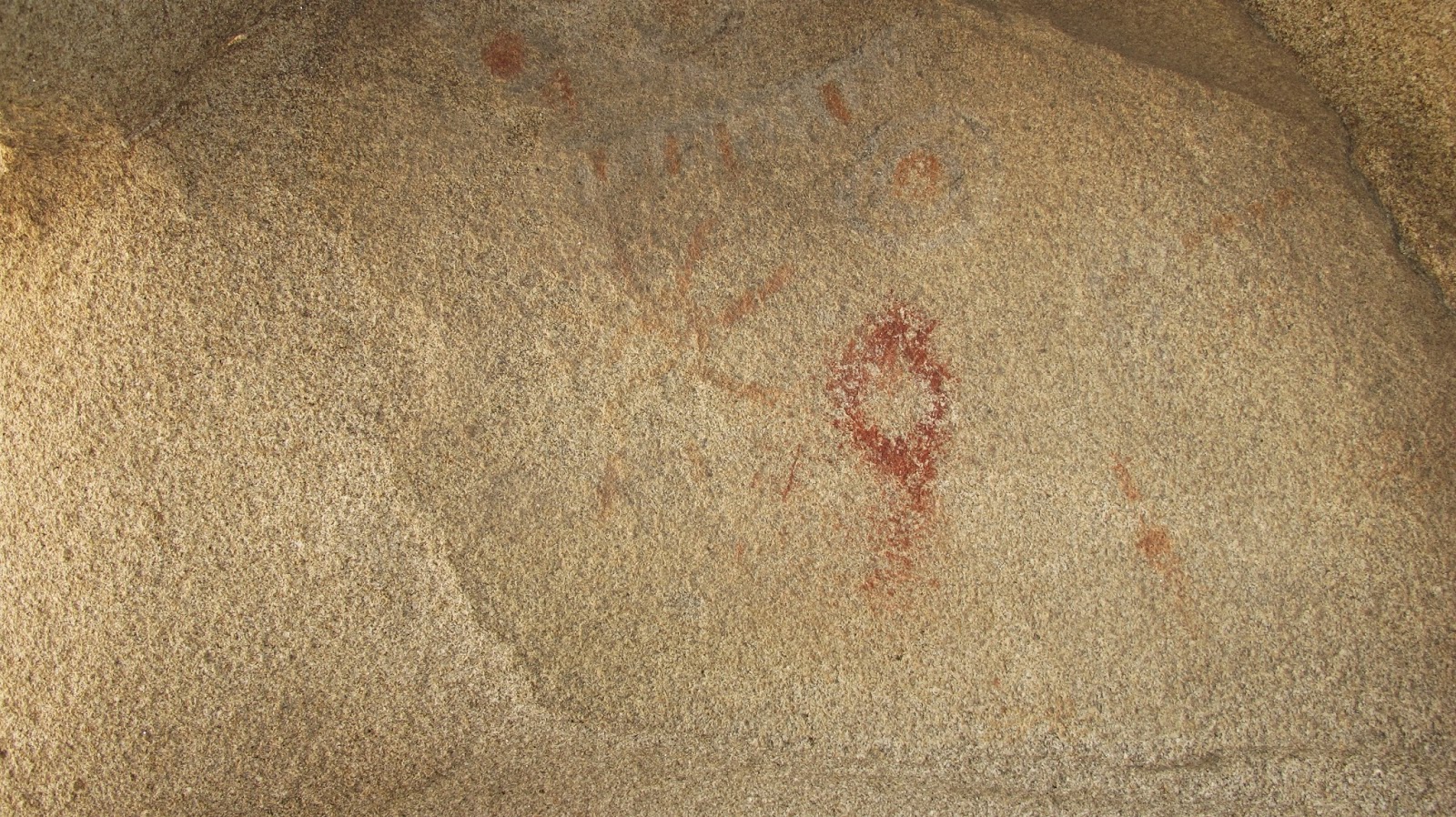
With Summer just around the corner I was reminded of the migrations of the Kumeyaay to find a cooler climate, new food resources, and water.  This area offered all those prospects in a predictable or reliable way.  This small shelter resides above a creek and faces east towards the rising sun.

While I was growing up my father took me to sites in the area as we shared a growing appreciation for the Kumeyaay culture and its mysteries.  At that time there was a large and clean spring in the area.  Today it is befouled and polluted, sucked nearly dry by invading Tamarisk.  It is a sad site to see.  Steps are being taken by Anza Borrego State Park to eradicate the Tamarisk and restore the once beautiful landscape of the area.  If we are fortunate we can restore the useful harmony seemingly portrayed in the rock art at this site and other sites in the area.

My father took me on many walks in this area as a boy.  Once we walked up this granitic sand dune close to sunset.  It was early summer and it was still warm out.  He asked me, "Don, do you know how I know there is a God?"
"No", I said.
"Dig into the sand at your feet" my dad suggested.
After scooping out sand and digging a little hole, I came across a small sand dollar.  Then several more.  It seemed the dune was full of them.  It was like digging at the sea shore, yet we were more than 4000 feet above sea level in the mountains and nearly 100 miles away.  It didn't seem likely to me that these were trade items as they were spread over the dune.  All that was left was to think that the Creator had played a role in putting them there when the earth was much different.  Like so many things from the past, what actually happened is unknowable.

Click on photos to enlarge - copyright 2014.  Don Liponi.


Tuesday, April 8, 2014

Kumeyaay Rock Art. Shout out to the Campo and Manzanita Bands of the Kumeyaay Nation. Thank you for your support. Southern California Rock Art.


It was truly heartwarming to hear that the members of the Kumeyaay Nation are supportive of our effort to photograph their rock art sites and use digital restoration on the resulting images.  This is an attempt to honor past and present Tipai/Kumeyaay who created and are trying to preserve these spiritually inspired messages.   We can all do our best to preserve what is left from these ancient communications, just we would with early Christian, Jewish, or Buddhist documents.

The beautiful, red, triangular grids shown below are some of the brightest pictographs in the area west of the Colorado Desert and in the rain zone.  This rock shelter and the surrounding area has other art that, to me, is just as enigmatic.

Perhaps one day we will understand more of what the Shaman was trying to tell his people and what it means to us.

Click on photo to enlarge.  Copyright 2014 - please no copies without permission.
Don Liponi


Friday, April 4, 2014

Kumeyaay or Quechan Petroglyph. Imperial County Rock Art. Kumeyaay Rock Art. Southern California Rock Art.


In the area of Indian Pass in Imperial County, west of the Colorado River, there are at least several petroglyphs within a short distance of the road.  Usually found on  isolated boulders like the one shown below.  This one is located in a small drainage and is covered in circles.  It is probably the most photogenic of the ones I have seen there. 

These "baked" rocks have an incredibly hard crust.  It takes a great deal of effort to chisel away and remove the patina.  The landscape in the area is just about Lunar or Martian in desolation.  These observations lead me to the theory that this design must have had some purpose.  Why else invest the hours it would have taken to create these petroglyphs?

Click on photo to enlarge.  Please do not use or reprint without permission.  Thank you.


Thursday, March 27, 2014

An Intimate Portrait of Kumeyaay circa 1950. Tipai [southern Kumeyaay or Southern Diegueno] of Baja California Ethonographic Notes [Book].

Hi Readers:
I highly recommend this book, “Tipai Ethnographic Notes.  A Baja California Indian Community at Mid-Century” [ca 1950]. William D. Hohenthal, Jr.  A cooperative publication of Ballena Press and the Institute for Regional Studies of the Californias.

A very unique publication that gives us an "insiders" view of the Tipai who lived in the area that we have just visited at La Rumorosa.  That village, as well as many other specific little villages are looked at in detail.  The descendants of the culture that produced a vast inventory of rock art and a rich cultural display are brought to life during a period that they are facing the explosion of intruding cultures.

This larger paperback is priced around $10 and has glowing reviews on the cover by Ken Hedges, Richard Carrico and Jerry Moore.  So many books have been written about what Kumeyaay life might have been like - here we get a first hand account of what it was like without the speculation.  Such a book adds immeasurably to my wanderings as I see so many "markers" of  habitation, if I only had an idea of their significance in everyday life.

See you on the trail.
Don Liponi

Patayan Rock Art? Western Arizona Rock Art. Searching for the roots of the La Rumorosa style. Southern California and San Diego Rock Art.

Dear Readers:
At the moment, I am about 3 months behind on working on images of sites I have visited. One of my teachers has suggested that the Kumeyaay La Rumorosa style may have had its roots to the east of Kumeyaay territory.  This is a small fragment of a magnificent panel in western Arizona, where, some researchers believe the roots of the  La Rumorosa style were born.  Others believe that the style developed more or less along the same timeline as the Kumeyaay style.    According to Broyles, et al. 2012 wrote on page 61: "...it cannot be proven whether the....rock art [below] was made by Yuman speakers (Quechan, Cocopah, Yavapai, Kamia/Kumeyaay), Piman speakers (Hia C'ed O'odham), or possibly their prehistoric ancestors..." [Patayan, in this case].

As a comparison, the first photo is as the element appears and the second photo is enhanced by D-stretch processing.  Click on photo to enlarge.  Please do not use photo without permission.   If you want to see a possible Quechan pictograph panel, another Kumeyaay art contemporary, come to the next meeting of the SDRAA scheduled for April 6th.   I will give a short presentation on a this site with an informative commentary by Ken Hedges that I can assure you will be lively and instructive!  How and where did Kumeyaay rock art evolve from?
Don Liponi


Notice on both paintings the red pigment has been over-painted with the black and I did not enhance it in DS for clarity.

Thursday, March 20, 2014

Kumeyaay Rock Art from Baja California. Trapezoidal Shaped Anthropomorph. Baja California Pictographs. San Diego Rock Art Association.

This D-stretched photograph contains at least 3 anthropomorphs that do not have the typical body shape for Kumeyaay pictographs, with the exception of the splayed fingers.  Our thanks to Jon Harmon, the developer of D-stretch, for creating the technology that allows us to observe this extensive panel, for it is nearly invisible to the unaided eye or camera.  One could walk right by this rock and never see even a spot of pigment.  The pictographs are out in the open, facing south in the sun and exposed to the rain.  Click on the photo to enlarge.


If you live in Southern California or Baja California, please come to one of our meetings and consider joining San Diego Rock Art Association.  Not only will you see more rock art at our meetings, you can become involved in saving and documenting local and regional pictographs and petroglyphs in the field.  See our main website at:

http://www.sandiegorockart.org/

Wednesday, March 12, 2014

Current Kumeyaay article on their Cultural Landscape in Baja California - Lynn Gamble and Michael Wilken-Robertson. Kumeyaay Rock Art, Baja California.

SDRAA and friends:

Below is a link to a current description of what it is to be a Kumeyaay living in Baja California, with first hand accounts of their contemporary conceptions of their world.   This also has some application to Norte California.  It is both heart warming and heart breaking.  I highly recommend this article for anyone who wants an intimate account of the Kumeyaay world: where there are no casinos and the acorn is still a staple, and why certain rocks and rock art are so important.  The Kumeyaay women interviewed live in the area of La Rumorosa that we have just visited.  Please follow link below to a PDF file for your reading enjoyment.

http://www.anth.ucsb.edu/sites/secure.lsit.ucsb.edu.anth.cms/files/sitefiles/people/gamble/Gamble%20and%20Wilken%2008.pdf

Saturday, March 8, 2014

Kumeyaay petroglyphs in Baja California. Kumeyaay Rock Art. Kumeyaay Shaman. California Rock Art.

I have to admit that I used to believe that I had to leave San Diego and Imperial Counties to see impressive petroglyphs.  A subjective statement to be sure.  The pictures I have seen of the petroglyphs in Pinto Canyon always impressed me, but it is currently a potentially dangerous place to be.  About the most extensive petroglyph site that I am aware of occurs in the region of the border of San Diego and Riverside Counties.  In all honesty, I am not sure if this is in Anza Borrego State Park or not.  In any case, in searching for "Utah Class" of petroglyphs within a few hours of San Diego, that has both beautiful desert scenery and friendly site stewardship -  the answer to me has become - Baja California.  To many of us that spend so much time trying to see a portion of the rock art of the Southwest, it is easy to forget how much magnificent art there is in Baja California apart from the large murals of Central Baja.  We know that the Kumeyaay used the canyons on the eastern side of the Southern California Peninsular Range as seasonal routes and for the abundance of resources found there.  Not surprisingly, the same situation exists along the eastern side of the Sierra Juarez Mountains of Baja California.  I was impressed to hear that the Kumuyaay range was as far south as a 100 miles into Baja California.  This is one of their Shaman's work about 30-40 miles south of the border in a year round creek at the bottom of the Sierra Juarez.  Currently, the Pets are about 10 feet above the water.  The area reminds me of Carrizo Gorge in ABSP and the Garden of Eden it was 20-30 years ago when it was flush with water and devoid of Tamarisk trees.  Not a spot of trash or graffiti anywhere.  This panel is about a mile from the nearest 4WD road.  It is easy to imagine the Kumeyaay villagers here in their pre-contact serenity. Click on photo to enlarge it.  Photos copyright Don Liponi 2014.


Tuesday, February 25, 2014

A few images from La Rumorosa, Baja California - Kumeyaay Rock Art. San Diego Rock Art Association Field Trip


Just a few peeks from the San Diego Rock Art Association field trip to La Rumorosa, Baja California last week-end.  Some photographs are as untreated and the others are D-stretched.  La Rumorosa is a State Park of Baja California and is managed by Mexico's National Institute of Anthropology and History [INAH].  We saw literally hundreds of elements and some panels are amazingly dense with multiple layers of pictographs.  The fourth photograph is of Diablito, also known as the Sun Watcher.  The small figure was determined to be a solstice marker in a published study by Archaeologist, Ken Hedges [please see Rock Art Papers, Volume 4: 17-32; 1986].  There are at least 3 of the "three headed" like anthropomorphs at the site, which, as far as I know, are unique within Kumeyaay pictographs.   We would like to thank our hosts, both of INAH and the Kumiai Community Museum in Tecate, Baja California, which is an amazing tribute to this culture housed in a beautiful setting of its own.  Click on photo to enlarge.  These photographs are copyright by Don Liponi, 2014.


Sunday, February 23, 2014

Wonderful day with SDRAA at La Rumorosa, Baja California. Baja Mexico Rock Art of the Kumeyaay.


San Diego Rock Art Association Field Trip to La Rumorosa - Baja California Rock Art - Kumeyaay Rock Art

 
Members of the San Diego Rock Art Association about to begin a field trip to the Rock Art sites of La Rumorosa, Baja California, led by Archaeologist Ken Hedges.  Ken is a major contributor to a variety of research performed on this magnificent site.  La Rumorosa is not only the largest Kumeyaay site of the La Rumorosa style of rock art, the site contains many elements not found at other sites within Kumeyaay territory.  After episodes of vandalism, the Mexican government has taken steps to restore and protect this world status prehistoric rock art gallery.  La Rumorosa is an easy trip from Tecate, Mexico via a modern toll road.  All trips are guided and this State Park contains a picnic area and modern bathrooms with immediate access just north of the toll road.  Some photos taken of the pictographs during our visit will follow this post.


Saturday, February 15, 2014

Rock Art Speculation: Kumeyaay Rock Art, Southern California Rock Art, San Diego Rock Art

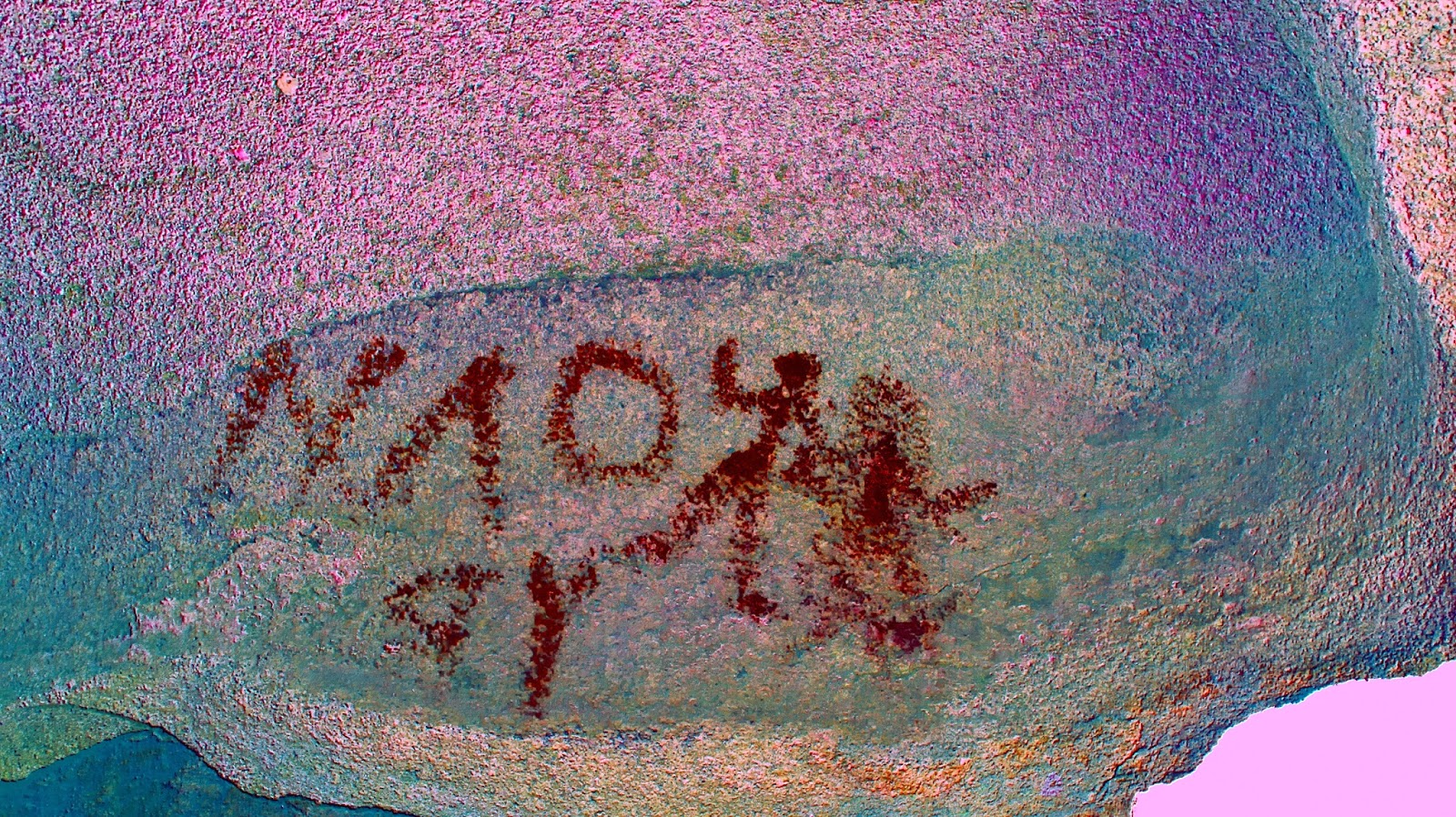
Several years ago, this was the first pictograph panel I found in a survey area that must have been seasonal home to several hundred or more Kumeyaay Native Americans that have occupied most of land now known as San Diego and Imperial Counties and Northern Baja California.  While most of the existing pictograph panels are thought to have been painted within the last 500 years, few, if any of the desert panels have been dated by new, more reliable dating methods.  I always wonder if the Kumeyaay artist/shaman who renders an individual panel is still living in "pre-contact" days - before the Spanish and before the other Europeans essentially committed genocide on these people.  Then they weren't Native Americans, they were just the Kumeyaay.  In a land where few modern men could survive, they had achieved a great knowledge or respect of nature that allowed them to meet their physical and economic needs.  At the same time, the Shaman, whose work survives on this granite wall paints what might be a story of physical to spiritual transformation.  The anthropomorph on the left is just a simple painting of a man, while the being on the right may be a scintillating spiritual form.  This being may be what the Shaman must become, to lead his people by contact with the spiritual world.  Unfortunately, as what usually happens in our world, then, as now, spirituality is crushed by men who are too scared or greedy to live that way and condemn any who are, to be locked up in prisons or reservations, or to a physical death.


Close up of panel using D-Stretch.  Click on to enlarge.  Copyright 2014 by Don Liponi.
Interpretation of writing [if any] is on my list of things to do.  Any Kumeyaay feel free to contact me through SDRAA if you know what the writing means.  Thank you.


See you on the trail.


Wednesday, February 5, 2014

Famous Malcolm Rogers Panel - Southern California Rock Art - California Rock Art.

Malcolm Rogers rediscovered this panel, probably in the 1930s in Imperial County close to several "tanks" or water pools.  The panel is rarely in the sun and is protected from the rain.  Thankfully, some of the panel is still visible although portions have faded away or have been lost to rock delamination.  The panel is very difficult to reach involving exposure, climbing and distance.  Please click on photo to enlarge it.


I increased the contrast and clarity of the panel in Photoshop.  D-stretch was not used.
Copyright 2014 Don Liponi.  Do not reprint without written permission.  Thanks.

Sunday, January 26, 2014

Disappearing Kumeyaay Rock Art Restored. San Diego County/Southern California Pictographs. SDRAA.

In a very small Granitic wind pocket, barely large enough for one smaller person, is this possibly celestial themed pictograph panel.  The Granite is nearly pure white and solidly protects the art from the outside elements.  However, the panel has faded to near invisibility in the past 30 years [see photograph one] since a previous sketch was made.  Only through the use of modern technology can the panel be somewhat restored although I have not back corrected the colors. [see photograph 2]  There is more artwork in this very large "village" site that spanned a creek and offered much to eat in the surrounding vegetation.  While the panel has survived wind, water, and vandalism, the paint itself has limitations especially on the porous substrate.  As usual, click on photo to enlarge.  All of my photos on this Blog are copyright, 2013-2014, so please don't reproduce without permission.  Thanks.
See you on the trail,
Don
 
Photograph 1 as Panel appears in 2013
 
Photograph 2 as Panel appears enhanced by D-stretch
*The Blue color may actually be White and could
by an artifact of D-stretch processing?

Tuesday, January 21, 2014

Lost Kumeyaay Pictograph relocated after 40 years. Shaman Rock Art? Not in Anza Borrego State Park, but in San Diego County's In Ko Pah Mountains.

 During the pre-handheld GPS years [before 2000], site reports for government and private industry evaluations were based on interpolations or extrapolations of reading old topographical maps and making an estimation of what the GPS might be.  It obviously was a difficult process. Working with modern technology, accurately measured GPS may place a site 100-200 meters off from the old estimates.  In a mountainous region made up of thousands of boulders and scores of rock shelters, this can take hours, days or even more.  Since it is labor and cost intensive to relocate the actual and true position, many site record archives perpetuate the old and erroneous positions.  When a new grant for research is funded, in some cases, the rock art is never relocated and "new conclusions" are reached on old information, old photographs or sketches and incorrect location.  How can their be progress in the study of rock art, when it is based on these illusionary foundation aspects that few have time to correct.  By walking the land of our Native American Predecessors and collecting accurate, basic data about the rock art sites, we have a chance to take one last, academically honest, look before the painting disappears.  When that happens?  Subsequent rock art investigations will all be speculation in absentia.   Ethnography and other empiric approaches may become meaningless as the actual endpoint of the hypothesis will be unknown.  Without the location, the context is gone, the ethnography may not be able to connect to the lost site.  If you love rock art and the wilderness why not have the experience and the euphoria of finding a beautiful "lost" piece of history.  Lots of people and organizations would love to have your help in San Diego and beyond.  Contact SDRAA and you can walk with us and others into these mysteries of the past.  Below is a small Kumeyaay grid, one of many designs and shapes.  The bright green and black markings are lichen.  The first photo is how the pictograph appears and the second photo is enhanced with D-stretch.
See you on the trail,
Don
As it appears in 2013


And with D-stretch enhancement, below

Sunday, January 12, 2014

Utah Rock Art: Freemont, Anasazi, Barrier Style Nearly Demolished by Greed for more Oil and Gas in the San Rafael Swell.

Hard to believe that certain elements in the BLM came very close to selling Gas and Oil Leases in the San Rafael Swell that would have either eliminated or impacted these beautiful pictographs.  For now, because of the actions of URARA and other Rock Art preservation groups, including several members of SDRAA, these actions have been curtailed for the moment.  We need to remember that we lost Glen Canyon to the "need" to create Hydroelectric Power.  We nearly lost Davis Canyon and the unique and beautiful Davis Faces to a Nuclear Power plant.  Here in San Diego we lost many of the Rancho Bernardo Rectilinear Mazes to Water Powering systems for urban sprawl.  Home sprinkler systems destroyed many of the mazes before they could even be photographed adequately, let alone studied.  To me and many others, the illusion of Power in the form of destroying nature and these Spiritual Visions are examples of man's emptiness and fear of the Spiritual World.  As a culture, we would do better to amplify our Spiritual communication.  Here are a few examples of spiritual gateways that were up for obliteration.  If this bothers you -- join and support your local Rock Art Society.  Help preserve the spiritual past of the Native Americans before the Euro-American Genocide.  Volunteer to help educate and defend what is left of our wilderness.  If you need a primer for this - read Desert Solitaire by Edward Abbey. [Click on photo to enlarge it].


See you next time!
Don

Friday, January 10, 2014

Another Interesting Kumeyaay Pictograph Approach! San Diego Country/Southern California Rock Art.

One of the things that helps my arthritic body is that the Kumeyaay often produce their art at ground level or close to it.  True, some "Solstice Sites" are up high, but, in general, most of their panels do not involve long upward climbs, or life threatening ledges so common in areas of Freemont or Anasazi culture.   To my surprise the "village" was located in roughly in the place it was supposed to be.  Even the Rock Shelter description matched, however, the described pictograph was no where to be found.  I crawled around in other shelters, but nothing.  As I walked out on a granite ledge, I took in the entire site, looking for possible overhangs or pockets that might hold a pictograph .  What I saw, reminded me of Utah and not the Kumeyaay. Twenty feet up in a pocket that was probably reachable by a ladder or tree was a small anthropomorph.  Since I usually only carry a wide angle lens, I could only take a photo from a distance and hoped that the resolution would hold up.  The figure is in black and is just above the 90 degree upward turn of the rock that creates the ledge where the artist may have sat.  Here is that image: [click on image to enlarge it]


Tuesday, January 7, 2014

More Kumeyaay Pictographs from the Catacombs of the In Ko Pah Mountains

After 6 separate attempts to locate a site using the site record from the 1970s [pre-Handheld GPS], I finally think I found it about 200 yards from where it "should have been".  Relocating old rock sites is a great adventure and a very useful way to give something back to the avocation that so many of us love.  If you love camping, wilderness exploring and walking the same ground as prehistoric or historic Native Americans, it is amazingly interesting and an authentically spiritual experience.

In this one area of about 50 x 50 square yards was a complex catacomb that must have played a role in the local Kumeyaay group.  My descriptions may have little basis in reality, they are only for identification of the photo purposes.  There is a picto/petro-glyph of what might be a white sun design with "rays" coming off the circle.  It faces the morning sunrise.  There is also a double cross deep in the catacomb done in black charcoal.  In another image, there is what might be an offering wind pocket and below it is what looks like an image of a fish [Lake Cahuilla was within walking distance].  The little wall pocket right next to the fish almost looks like an offering "cup". A few yards away is what appears to be a pictograph "Yoni" with a pebble shrine.  This also faces the morning sun. There is a similar pictograph about a mile to the north. There is more at this site and abundant milling.  All of my photographs are copyright by Don Liponi 2017.  Please do not duplicate in any fashion without my written permission.  Thank you!


Thursday, December 26, 2013

A Supplicator or Praying figure in San Diego?? Are there other such Pictographs or Petroglyphs in San Diego or Imperial Counties?

This faint pictograph was in a series of shelters at ground level in very east San Diego County.  It was facing east near the entrance to the shelter.  The shelter entrance was blocked by vegetation.  Interestingly, far back in the maze of shelters is a black anthropomorph on the ceiling.  It was a more typical limbs spread pose, in a room that would receive setting Sun exposure.  That room did contain a prayer stick and some quartz crystals.  The photos include how the pictograph appears without any processing and after digital enhancement including D-stretch.


While similar to Supplicator figures in Utah [ie, Black Dragon Canyon in Utah's San Rafael Swell], the meaning of such a figure in Kumeyaay culture may be different.  Still, its a motif I have not seen locally.  Would appreciate any feedback from the members on their experiences or thoughts.  Are there other examples in Southern California?

Friday, December 20, 2013

Another variant of Kumeyaay art - enhanced with D Stretch. San Diego Country/Southern California Rock Art.


Rock Art lovers.  The more I actually look for rock art in Kumeyaay territory, the more I become surprised at the diversity of this "style".  This is a very light petroglyph in a catacomb shelter featuring several rooms.  This element is on the ceiling above several prayer sticks along with some other features, mostly anthropomorphs.  Most of the elements have an open box like feature.  Other shelters nearby that have pictographs or petroglyphs appear to have been drawn by the same individual or a copyist.  Is it possible, since the petroglyph is high up on a mountain, that this is some rendition of the constellation Orion?  It apparently played a role in the Kumeyaay calendar.  The "belt" of Orion is missing, but certainly the rest of the petroglyph is compatible.

Wednesday, December 11, 2013

Unusual local Kumeyaay pictograph. Jacumba Mountains in San Diego Country - Rock Art.


Obviously, a D-stretched version of a nearly invisible pictograph from the local transition zone [mountain to desert].  All I could see were some black lines and a speckle of red prior to DS processing.  I want to call this a bouquet of flowers, but interpretations have often been my downfall, so I must be learning.  This site is high above a village at the top of a ridge.  Off to the right is a pictograph that resembles a Vulva in black.  A large pot drop is a few feet away.  Whatever the image may actually be, it is very beautiful, so it is worth sharing.  More at the next meeting.  I am off to the desert to find some additional sites in a few minutes. It is COLD!  Hope to see you out there.

Friday, November 8, 2013

Solid body human/spirit form variant from the Ipai Man form of Valllecito and other sites. Rock Art of Imperial County and Southern California.


A pictograph as it appears at the top of rock hill in an area in East San Diego County with at least 3 "solid" body sites within 2 miles of each other in 3 separate canyons.  At variance to the more commonly portrayed splayed extremities, fingers and toes.
After D-Stretch processing.  Granite has exfoliated at left elbow and left thigh.  Since the 3 sites are so close, I wonder if this is this a "sub-La Rumorosa" style or is it the work of a single artist.  Can other members think of other sites with this more "ordinary" portrayal of the a manlike/spirit form?  BTW, pictures are great and easy to do.  If you want to put into words other examples, please keep locations general.