Sunday, January 26, 2014

Disappearing Kumeyaay Rock Art Restored. San Diego County/Southern California Pictographs. SDRAA.

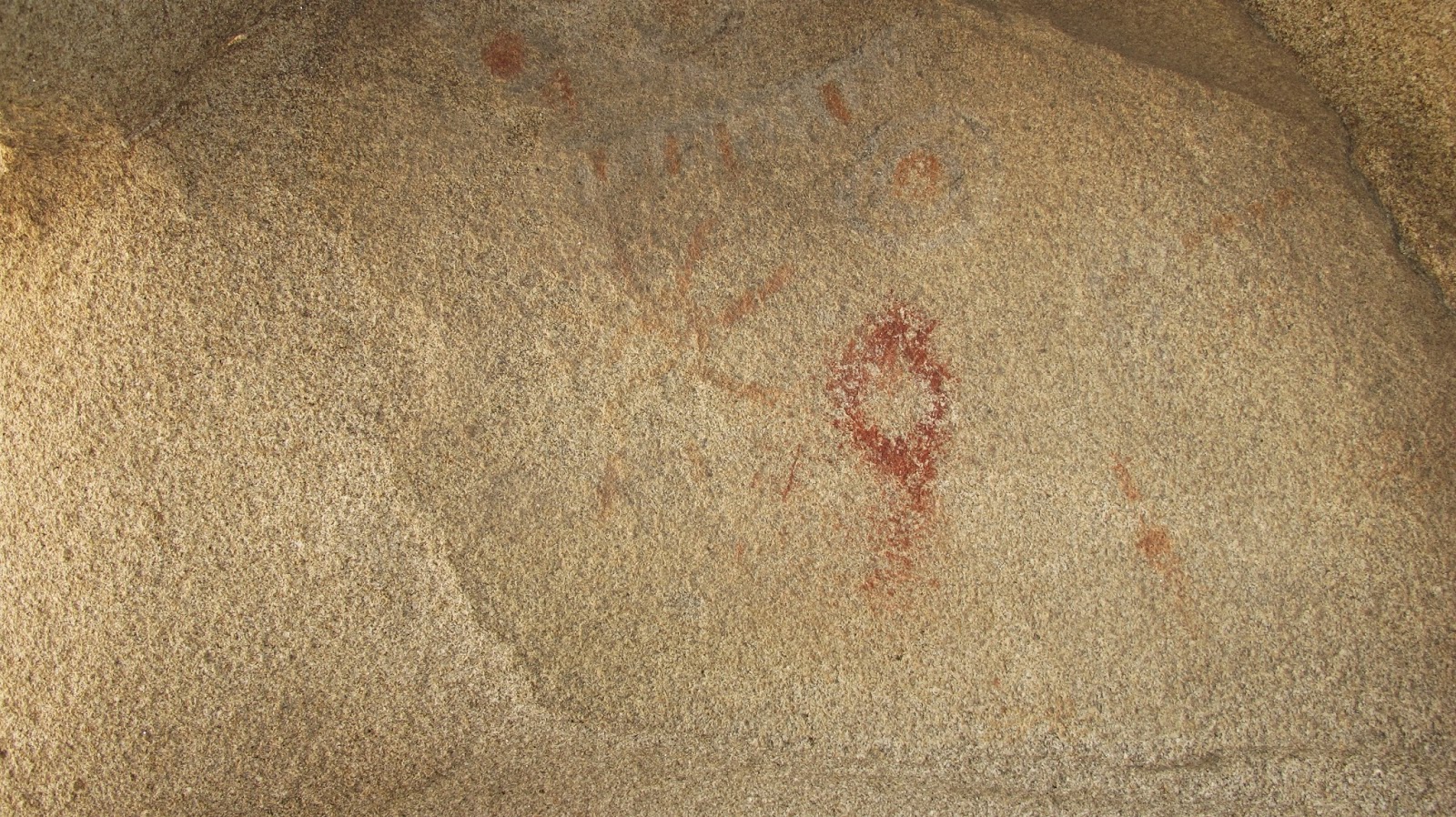
In a very small Granitic wind pocket, barely large enough for one smaller person, is this possibly celestial themed pictograph panel.  The Granite is nearly pure white and solidly protects the art from the outside elements.  However, the panel has faded to near invisibility in the past 30 years [see photograph one] since a previous sketch was made.  Only through the use of modern technology can the panel be somewhat restored although I have not back corrected the colors. [see photograph 2]  There is more artwork in this very large "village" site that spanned a creek and offered much to eat in the surrounding vegetation.  While the panel has survived wind, water, and vandalism, the paint itself has limitations especially on the porous substrate.  As usual, click on photo to enlarge.  All of my photos on this Blog are copyright, 2013-2014, so please don't reproduce without permission.  Thanks.
See you on the trail,
Don
 
Photograph 1 as Panel appears in 2013
 
Photograph 2 as Panel appears enhanced by D-stretch
*The Blue color may actually be White and could
by an artifact of D-stretch processing?

Tuesday, January 21, 2014

Lost Kumeyaay Pictograph relocated after 40 years. Shaman Rock Art? Not in Anza Borrego State Park, but in San Diego County's In Ko Pah Mountains.

 During the pre-handheld GPS years [before 2000], site reports for government and private industry evaluations were based on interpolations or extrapolations of reading old topographical maps and making an estimation of what the GPS might be.  It obviously was a difficult process. Working with modern technology, accurately measured GPS may place a site 100-200 meters off from the old estimates.  In a mountainous region made up of thousands of boulders and scores of rock shelters, this can take hours, days or even more.  Since it is labor and cost intensive to relocate the actual and true position, many site record archives perpetuate the old and erroneous positions.  When a new grant for research is funded, in some cases, the rock art is never relocated and "new conclusions" are reached on old information, old photographs or sketches and incorrect location.  How can their be progress in the study of rock art, when it is based on these illusionary foundation aspects that few have time to correct.  By walking the land of our Native American Predecessors and collecting accurate, basic data about the rock art sites, we have a chance to take one last, academically honest, look before the painting disappears.  When that happens?  Subsequent rock art investigations will all be speculation in absentia.   Ethnography and other empiric approaches may become meaningless as the actual endpoint of the hypothesis will be unknown.  Without the location, the context is gone, the ethnography may not be able to connect to the lost site.  If you love rock art and the wilderness why not have the experience and the euphoria of finding a beautiful "lost" piece of history.  Lots of people and organizations would love to have your help in San Diego and beyond.  Contact SDRAA and you can walk with us and others into these mysteries of the past.  Below is a small Kumeyaay grid, one of many designs and shapes.  The bright green and black markings are lichen.  The first photo is how the pictograph appears and the second photo is enhanced with D-stretch.
See you on the trail,
Don
As it appears in 2013


And with D-stretch enhancement, below
Sunday, January 12, 2014

Utah Rock Art: Freemont, Anasazi, Barrier Style Nearly Demolished by Greed for more Oil and Gas in the San Rafael Swell.

Hard to believe that certain elements in the BLM came very close to selling Gas and Oil Leases in the San Rafael Swell that would have either eliminated or impacted these beautiful pictographs.  For now, because of the actions of URARA and other Rock Art preservation groups, including several members of SDRAA, these actions have been curtailed for the moment.  We need to remember that we lost Glen Canyon to the "need" to create Hydroelectric Power.  We nearly lost Davis Canyon and the unique and beautiful Davis Faces to a Nuclear Power plant.  Here in San Diego we lost many of the Rancho Bernardo Rectilinear Mazes to Water Powering systems for urban sprawl.  Home sprinkler systems destroyed many of the mazes before they could even be photographed adequately, let alone studied.  To me and many others, the illusion of Power in the form of destroying nature and these Spiritual Visions are examples of man's emptiness and fear of the Spiritual World.  As a culture, we would do better to amplify our Spiritual communication.  Here are a few examples of spiritual gateways that were up for obliteration.  If this bothers you -- join and support your local Rock Art Society.  Help preserve the spiritual past of the Native Americans before the Euro-American Genocide.  Volunteer to help educate and defend what is left of our wilderness.  If you need a primer for this - read Desert Solitaire by Edward Abbey. [Click on photo to enlarge it].


See you next time!
Don

Friday, January 10, 2014

Another Interesting Kumeyaay Pictograph Approach! San Diego Country/Southern California Rock Art.

One of the things that helps my arthritic body is that the Kumeyaay often produce their art at ground level or close to it.  True, some "Solstice Sites" are up high, but, in general, most of their panels do not involve long upward climbs, or life threatening ledges so common in areas of Freemont or Anasazi culture.   To my surprise the "village" was located in roughly in the place it was supposed to be.  Even the Rock Shelter description matched, however, the described pictograph was no where to be found.  I crawled around in other shelters, but nothing.  As I walked out on a granite ledge, I took in the entire site, looking for possible overhangs or pockets that might hold a pictograph .  What I saw, reminded me of Utah and not the Kumeyaay. Twenty feet up in a pocket that was probably reachable by a ladder or tree was a small anthropomorph.  Since I usually only carry a wide angle lens, I could only take a photo from a distance and hoped that the resolution would hold up.  The figure is in black and is just above the 90 degree upward turn of the rock that creates the ledge where the artist may have sat.  Here is that image: [click on image to enlarge it]


Tuesday, January 7, 2014

More Kumeyaay Pictographs from the Catacombs of the In Ko Pah Mountains

After 6 separate attempts to locate a site using the site record from the 1970s [pre-Handheld GPS], I finally think I found it about 200 yards from where it "should have been".  Relocating old rock sites is a great adventure and a very useful way to give something back to the avocation that so many of us love.  If you love camping, wilderness exploring and walking the same ground as prehistoric or historic Native Americans, it is amazingly interesting and an authentically spiritual experience.

In this one area of about 50 x 50 square yards was a complex catacomb that must have played a role in the local Kumeyaay group.  My descriptions may have little basis in reality, they are only for identification of the photo purposes.  There is a picto/petro-glyph of what might be a white sun design with "rays" coming off the circle.  It faces the morning sunrise.  There is also a double cross deep in the catacomb done in black charcoal.  In another image, there is what might be an offering wind pocket and below it is what looks like an image of a fish [Lake Cahuilla was within walking distance].  The little wall pocket right next to the fish almost looks like an offering "cup". A few yards away is what appears to be a pictograph "Yoni" with a pebble shrine.  This also faces the morning sun. There is a similar pictograph about a mile to the north. There is more at this site and abundant milling.  All of my photographs are copyright by Don Liponi 2017.  Please do not duplicate in any fashion without my written permission.  Thank you!


Thursday, December 26, 2013

A Supplicator or Praying figure in San Diego?? Are there other such Pictographs or Petroglyphs in San Diego or Imperial Counties?

This faint pictograph was in a series of shelters at ground level in very east San Diego County.  It was facing east near the entrance to the shelter.  The shelter entrance was blocked by vegetation.  Interestingly, far back in the maze of shelters is a black anthropomorph on the ceiling.  It was a more typical limbs spread pose, in a room that would receive setting Sun exposure.  That room did contain a prayer stick and some quartz crystals.  The photos include how the pictograph appears without any processing and after digital enhancement including D-stretch.


While similar to Supplicator figures in Utah [ie, Black Dragon Canyon in Utah's San Rafael Swell], the meaning of such a figure in Kumeyaay culture may be different.  Still, its a motif I have not seen locally.  Would appreciate any feedback from the members on their experiences or thoughts.  Are there other examples in Southern California?

Friday, December 20, 2013

Another variant of Kumeyaay art - enhanced with D Stretch. San Diego Country/Southern California Rock Art.


Rock Art lovers.  The more I actually look for rock art in Kumeyaay territory, the more I become surprised at the diversity of this "style".  This is a very light petroglyph in a catacomb shelter featuring several rooms.  This element is on the ceiling above several prayer sticks along with some other features, mostly anthropomorphs.  Most of the elements have an open box like feature.  Other shelters nearby that have pictographs or petroglyphs appear to have been drawn by the same individual or a copyist.  Is it possible, since the petroglyph is high up on a mountain, that this is some rendition of the constellation Orion?  It apparently played a role in the Kumeyaay calendar.  The "belt" of Orion is missing, but certainly the rest of the petroglyph is compatible.

Wednesday, December 11, 2013

Unusual local Kumeyaay pictograph. Jacumba Mountains in San Diego Country - Rock Art.


Obviously, a D-stretched version of a nearly invisible pictograph from the local transition zone [mountain to desert].  All I could see were some black lines and a speckle of red prior to DS processing.  I want to call this a bouquet of flowers, but interpretations have often been my downfall, so I must be learning.  This site is high above a village at the top of a ridge.  Off to the right is a pictograph that resembles a Vulva in black.  A large pot drop is a few feet away.  Whatever the image may actually be, it is very beautiful, so it is worth sharing.  More at the next meeting.  I am off to the desert to find some additional sites in a few minutes. It is COLD!  Hope to see you out there.

Friday, November 8, 2013

Solid body human/spirit form variant from the Ipai Man form of Valllecito and other sites. Rock Art of Imperial County and Southern California.


A pictograph as it appears at the top of rock hill in an area in East San Diego County with at least 3 "solid" body sites within 2 miles of each other in 3 separate canyons.  At variance to the more commonly portrayed splayed extremities, fingers and toes.
After D-Stretch processing.  Granite has exfoliated at left elbow and left thigh.  Since the 3 sites are so close, I wonder if this is this a "sub-La Rumorosa" style or is it the work of a single artist.  Can other members think of other sites with this more "ordinary" portrayal of the a manlike/spirit form?  BTW, pictures are great and easy to do.  If you want to put into words other examples, please keep locations general.